Cruise Internet Options
How Cruise Ship Internet Works (Satellite Explained)
Cruise ship wifi has a reputation - slow, spotty, and shockingly expensive, often running $20–30 a day for a connection that struggles to load a webpage. It's a strange contradiction: you're on a billion-dollar floating city packed with cutting-edge technology, yet you can't reliably check your email.
But once you understand what it actually takes to beam internet to a ship in the middle of the ocean, the price, and the performance, start to make a lot more sense.
Here's how cruise ship internet works.
How Cruise Ship Internet Works? The Short Answer
Cruise ships connect to the internet via satellite, since cell towers and cables don't reach the open ocean.
Most use VSAT technology linking to geostationary satellites 22,000 miles up, though newer ships are switching to Starlink's low Earth orbit satellites (just 340 miles up) for faster speeds and lower latency.
The signal is then distributed ship-wide through onboard wifi routers, shared among thousands of passengers, which is why it's often slower and pricier than home internet.
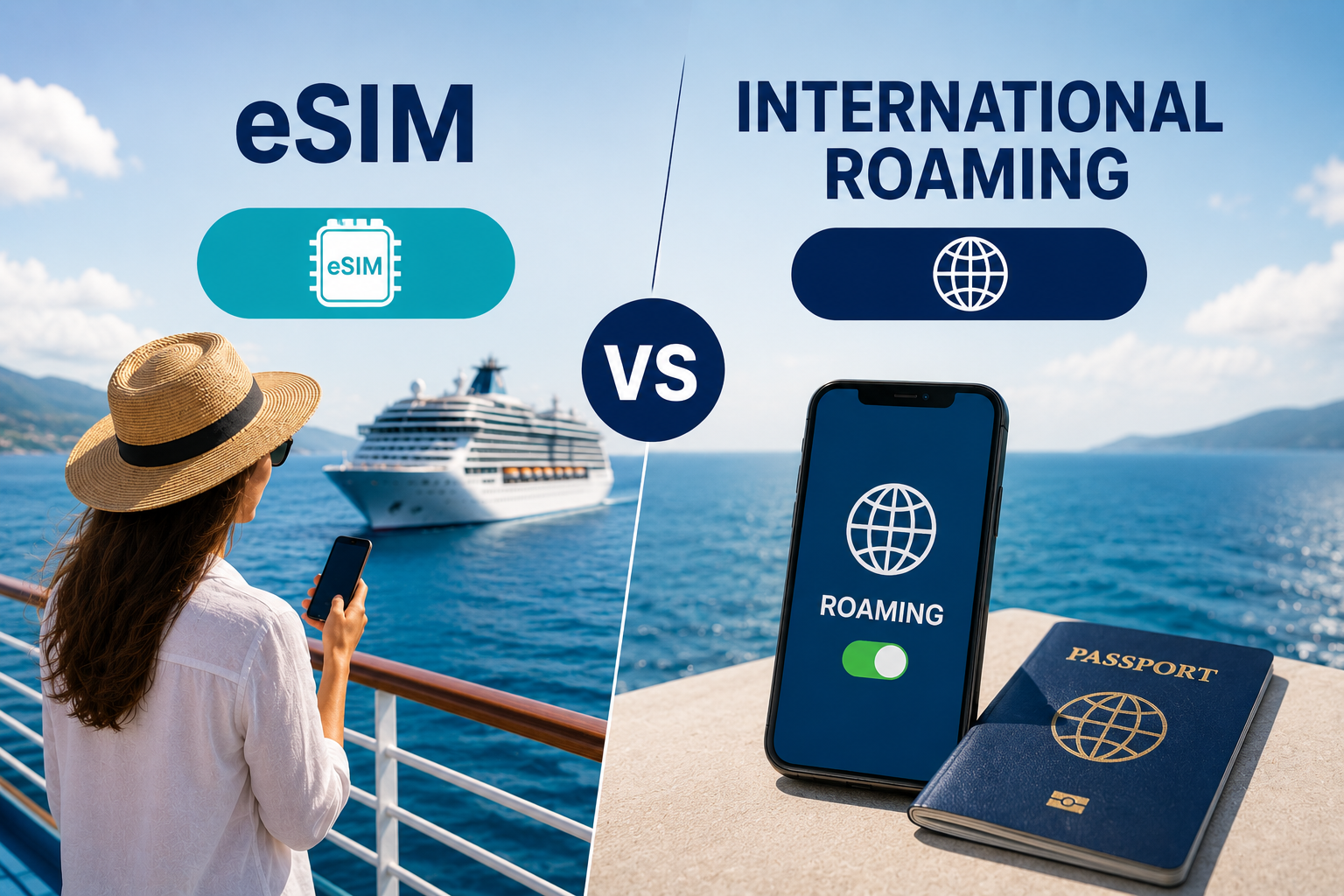
There are also other ways to get internet at sea. A cruise eSIM can provide mobile data by connecting to supported maritime networks, while international roaming may connect your regular SIM to a ship's maritime cellular network, often at much higher roaming rates.
The Basic Challenge: Connecting a Moving Ship in the Middle of the Ocean
On land, internet reaches your device through a mix of fiber-optic cables buried underground and cell towers spaced every few miles. Neither option exists in the middle of the ocean. There are no towers to ping and no cables to plug into, just open water for hundreds or thousands of miles in every direction.
And unlike a house or office, a cruise ship isn't a fixed point; it's a moving target, constantly changing position as it sails from port to port. That combination, no infrastructure and constant motion, rules out every kind of internet connection we take for granted on land.
The only realistic way to get a signal to a ship at sea is from above, which is exactly why satellites become the whole story.
How Cruise Ship Internet Works: The Two Main Satellite Technologies
Not all cruise ship internet is created equal. Most vessels rely on one of two very different satellite systems, and which one your ship uses makes a huge difference in your onboard experience.
VSAT
VSAT has been the industry standard for years.
It connects to geostationary satellites parked roughly 22,000 miles above Earth, which stay fixed relative to a single point on the planet - useful for a ship that needs constant coverage, but a serious drawback when it comes to speed.
Ships pick up the signal using the large dome-shaped antennas (radomes) you've probably seen mounted near the funnel; the dome protects the sensitive equipment inside from wind, salt, and weather while it stays locked onto the satellite as the ship rocks and turns.
The problem is distance: because the satellite sits so far away, data has to travel an enormous round trip, creating noticeable lag - video calls stutter, pages take time to load, and anything real-time feels sluggish. On top of that, VSAT bandwidth is limited and gets split among every passenger connected at once, which is a big part of why the wifi slows to a crawl when the ship is full and everyone's online.
Starlink
Starlink, SpaceX's low Earth orbit (LEO) satellite network, is changing that equation.
Instead of one satellite sitting 22,000 miles up, Starlink uses a constellation of satellites only about 340 miles above Earth. That shorter distance reduces latency and improves upload and download speeds at sea, making the connection feel much closer to home wifi than old-school satellite internet.
Adoption has moved fast: Royal Caribbean was one of the first adopters, and the technology has since spread to Norwegian Cruise Line's newer vessels, MSC Cruises, and Virgin Voyages, among others.
The difference isn't subtle. Passengers on Starlink-equipped ships report speeds in the 50–200 Mbps range, enough to stream video, hold video calls, and browse without the constant buffering that defined cruise wifi for over a decade.
How the Signal Gets From Satellite to Your Phone
Getting a signal from a satellite hundreds or thousands of miles above the ocean and onto your phone screen takes a few more steps than most passengers realize.
It starts with the ship-mounted antenna arrays - the domes or flat panels positioned high on the ship, usually near the funnel, where they have the clearest possible view of the sky. These antennas constantly track the satellite as the ship moves, rocks, and changes heading, automatically adjusting their angle to keep the connection locked in.
Once the signal is received, it's routed down into the ship and fed into an onboard network, essentially a scaled-up version of home wifi. Cables and access points distribute that connection throughout the vessel, with routers placed strategically in public areas, hallways, and cabin corridors to spread coverage across a ship that can stretch over a thousand feet long and hold more than twenty decks. That's also why signal strength isn't the same everywhere onboard.
Open public spaces like the pool deck, atrium, or lounges tend to sit closer to access points and have fewer obstructions, so they often get a stronger, more reliable connection. Cabins, especially interior ones deep in the ship's structure, have to contend with more walls, metal bulkheads, and distance from the nearest access point, which is why your wifi bars might drop the moment you head back to your room.
Why Cruise Ship Internet is So Expensive and Often Slow
The technology also explains the price tag.
Satellite bandwidth is a limited, expensive resource that cruise lines buy in bulk and pass on to passengers, unlike home internet, you can't just run another cable to add capacity.
That bandwidth then gets split among thousands of people at once: a single mega-ship can carry 3,000 to 6,000+ passengers all pulling from the same connection simultaneously. Usage spikes make it worse on sea days, when there's no port wifi or cell signal to fall back on and nearly everyone is online at the same time, straining the network far more than on port days when many guests are off exploring.
On top of all that, maintaining antennas and equipment exposed to salt air, wind, and constant motion at sea requires specialized upkeep that land-based providers never have to worry about. It's another cost built into every wifi package.
Other Ways to Get Internet on a Cruise Ship
The ship's own wifi package isn't the only option, and a few alternatives are worth knowing about.
There are also cruise eSIMs (many of them combined cruise-and-land eSIMs) that you can install on your phone before you sail, often at a lower cost than the ship's premium wifi packages.
That said, they still rely on the same underlying satellite or coastal cellular networks.
You may also see your phone pick up a signal from a "cruise roaming" or maritime cellular network while at sea, provided by partnerships between your carrier and companies operating cellular equipment onboard. This should generally be avoided: maritime roaming rates are notoriously steep, often charging several dollars per megabyte, and it's easy to rack up a bill of hundreds of dollars without realizing it, especially with background apps quietly using data.
The safest approach is to switch your phone to airplane mode (with wifi on) the moment you board, disable cellular data and roaming in your settings, and rely on the ship's official wifi package or a pre-purchased eSIM instead because both are far more predictable, and far less likely to deliver a nasty surprise on your next phone bill.
Read more:
Cruise Wi-Fi vs Cruise eSIM Cost: Which Saves You More Money?
Cruise eSIM vs International Roaming (2026): Which Is Better?
Featured photo by Crab Lens from Pexels