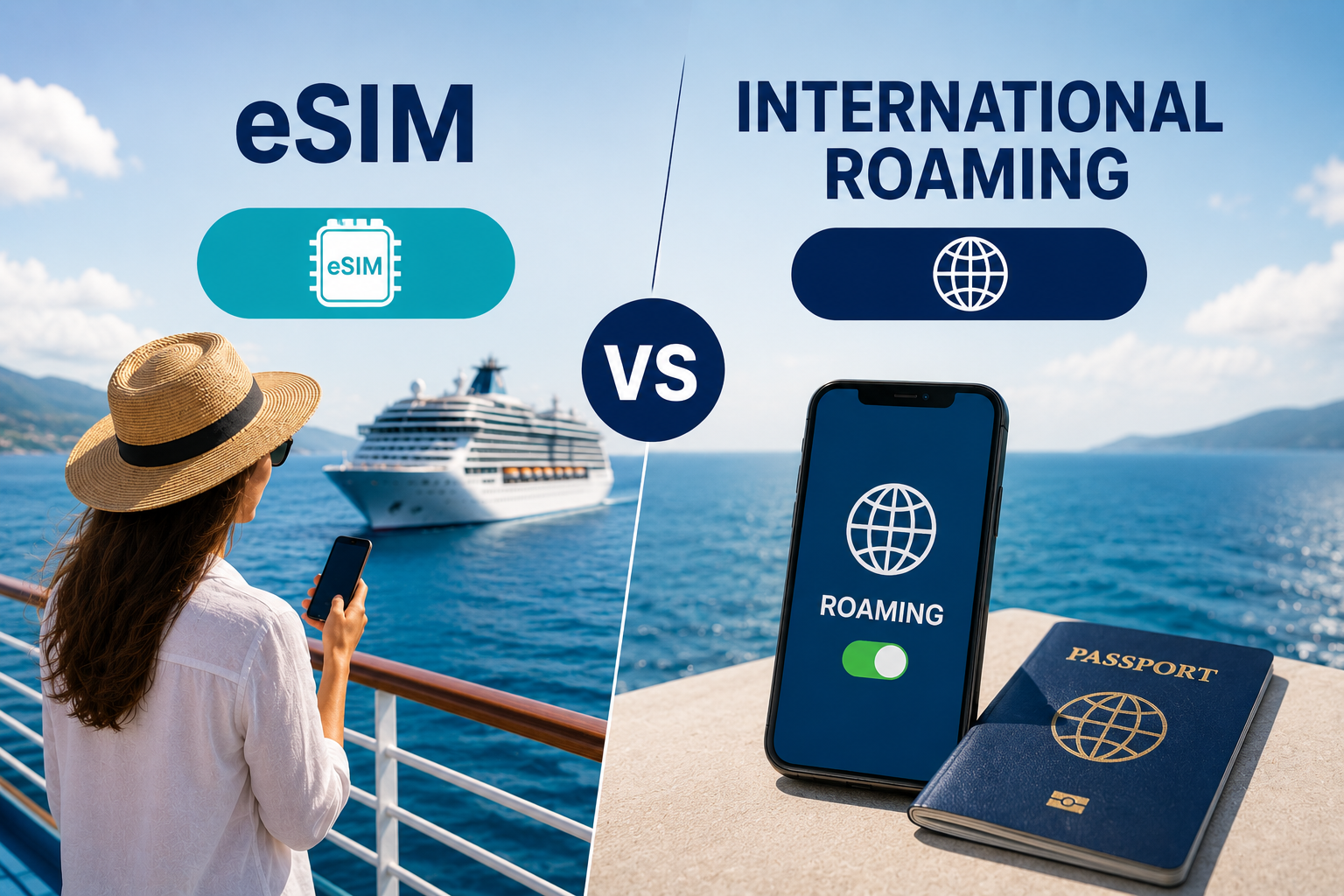
Cruise Internet and Connectivity
Cruise eSIM vs Travel eSIM vs Physical SIM for Cruise Travel
Both cruise eSIMs and physical SIM cards can help you stay connected while traveling, but cruise travel comes with unique challenges. You may visit several countries on one trip, cross multiple mobile networks, and spend days at sea without access to regular land-based coverage.
So, should you choose a cruise eSIM, a travel eSIM, or a physical SIM for your cruise? The best option depends on your phone, itinerary, destination coverage, data needs, and whether you need internet only in port or while at sea.
In this guide, we'll compare cruise eSIMs, travel eSIMs, and physical SIM cards to help you choose the right option for your cruise.
Cruise eSIM vs Regular eSIM vs Physical SIM for Cruises: The Short Answer
For most cruise travelers, an eSIM is more convenient than a physical SIM.
You can buy and install it digitally before your cruise, there's no physical card to swap or lose, and on compatible Dual SIM phones, you can keep your regular SIM active for calls and texts while using the eSIM for mobile data.
However, the type of SIM matters less than the coverage included with the plan. A standard travel eSIM and a physical travel SIM may both work well while your ship is in port but lose service once the ship sails away from land-based mobile networks.
If you want internet during days at sea, look for a cruise eSIM that specifically includes supported maritime coverage. Depending on the plan, eSIM for cruise can keep you connected at sea while also providing mobile data in supported countries and ports along your itinerary.
Read more:
Cruise eSIM vs Travel eSIM vs Physical SIM for Cruise Travel: Quick Comparison
The main difference between a cruise eSIM, regular travel eSIM, and physical SIM is not just how the SIM is installed. For cruise travelers, the biggest difference is where the plan can connect.
A regular travel eSIM or physical SIM is generally designed to connect to land-based mobile networks. This makes it useful when your ship is in port or sailing close enough to shore to receive a terrestrial mobile signal. Once the ship moves farther out to sea, however, that connection may disappear.
A cruise eSIM is specifically designed for cruise travel and includes supported maritime coverage, allowing you to use mobile data while at sea. Depending on the plan, it may also include land-based coverage in the countries and ports along your itinerary.
Feature | Cruise eSIM | Regular Travel eSIM | Physical SIM |
|---|---|---|---|
Physical card required | No | No | Yes |
Installation | Digital | Digital | Insert SIM card |
Can buy before your cruise | Yes | Yes | Yes |
Instant delivery | Usually | Usually | Only if bought in person |
SIM swapping required | No | No | Usually yes |
Keep regular SIM installed | Yes, on compatible Dual SIM phones | Yes, on compatible Dual SIM phones | Depends on available SIM slots |
Works in cruise ports | Yes, if land coverage is included | Yes, in supported destinations | Yes, in supported destinations |
Works at sea | Yes | Usually no | Usually no |
Multi-country coverage | Common | Common | Depends on the plan |
Designed specifically for cruises | Yes | No | No |
Easy to switch plans | Yes | Yes | Less convenient |
Risk of losing the SIM | No | No | Yes |
Requires eSIM-compatible device | Yes | Yes | No |
Best for | Staying connected at sea and in supported ports | Mobile data while in port/on land | Phones without eSIM or local connectivity |
What Is an eSIM?
An eSIM (embedded SIM) is a digital SIM built directly into a compatible phone, tablet, or other device. It works like a traditional SIM card but doesn't require you to insert or remove a physical card.
To use an eSIM while traveling, you typically:
Buy an eSIM data plan.
Install it digitally using a QR code, app, or activation details.
Select the eSIM as your mobile data SIM.
Connect when you enter an area covered by the plan.
One of the biggest advantages for travelers is that many modern phones support Dual SIM. This means you can keep your regular SIM active for calls and texts while using a separate travel eSIM for mobile data.
A regular travel eSIM typically connects to land-based mobile networks, so it may work in cruise ports but not when the ship is farther out at sea.
Read more: What Is an eSIM? Everything You Need to Know in 2026
What Is a Cruise eSIM?
A cruise eSIM is an eSIM plan designed specifically for cruise travel.
The main difference is its network coverage. While a standard travel eSIM primarily connects to mobile networks on land, a cruise eSIM can include supported maritime connectivity for use while the ship is at sea.
Depending on the provider and plan, a cruise eSIM can offer:
Mobile data while your ship is at sea.
Coverage in supported cruise ports and countries.
One plan for multiple destinations along your itinerary.
Digital installation without replacing your regular SIM.
Dual SIM use, allowing you to keep your normal SIM active while using the cruise eSIM for data.
This makes a cruise eSIM particularly useful for itineraries with multiple at-sea days or several countries.
However, not every eSIM advertised for travelers works at sea. Before buying, always check whether the plan specifically includes maritime coverage and whether your cruise route is supported.
Read more:
What Is a Physical SIM?
A physical SIM is the traditional removable SIM card that you insert into your phone's SIM tray.
It stores the information your phone needs to connect to a mobile network.
For international travel, you might use:
A local SIM purchased at your destination.
An international travel SIM.
A regional SIM covering several countries.
A SIM with international or specialized roaming coverage.
Your regular home-country SIM with data roaming enabled.
Physical SIMs can still be useful, particularly if your phone doesn't support eSIM. However, they can be less convenient on cruises visiting multiple countries because you may need to buy or swap SIM cards along the way.
If you use your regular physical SIM abroad, be careful with data roaming. Your carrier may charge international roaming fees when your phone connects to a foreign network. These charges can become especially expensive on a cruise if your phone connects to the ship's maritime network, which may be billed separately from standard international roaming and often has higher rates.
To help avoid unexpected charges, check your carrier's cruise and international roaming policies before departure. You may also want to turn off data roaming, disable automatic network selection, or keep your regular SIM active only for calls and texts while using a separate travel plan for data. If you remove your physical SIM, store it safely so it does not get lost or damaged.
Like a regular travel eSIM, a standard physical SIM generally relies on land-based cellular networks. Unless the plan specifically includes maritime connectivity, it may stop working once your cruise ship moves beyond land-based coverage.
Read more: Cruise eSIM vs International Roaming (2026): Which Is Better?
The Biggest Difference for Cruises: At-Sea Coverage
When comparing a regular travel eSIM, cruise eSIM, and physical SIM, the most important difference isn't whether the SIM is digital or physical. It's where the plan can actually connect.
Regular travel eSIMs and most physical travel SIMs rely on land-based cellular networks. They can work well while you're in port, exploring a destination, or sometimes while the ship is still close enough to the coast to receive a terrestrial mobile signal. But once the ship sails farther offshore, those networks may no longer be available.
Here's how the three options generally compare:
Regular travel eSIM: Usually connects to partner mobile networks on land. It's useful for port days and multi-country travel, but typically won't provide connectivity when you're farther out at sea.
Physical SIM: Also generally relies on terrestrial mobile networks. A local or international physical SIM may work in supported ports but normally won't keep you connected in open water unless its plan specifically supports maritime roaming.
Cruise eSIM: Designed specifically for cruise travel and can include supported maritime coverage, allowing your phone to connect while the ship is at sea. Depending on the plan, it may also provide regular mobile data coverage when you arrive in supported ports and countries.
For example, a Mediterranean cruise might visit Spain, France, Italy, and Greece. A regional travel eSIM or physical SIM could provide excellent coverage while you're exploring those countries. However, during an at-sea day between destinations, the phone may lose its land-based connection. A cruise eSIM with coverage for the relevant maritime area is designed to provide connectivity during those parts of the journey as well.
This is why coverage should be the first thing you check when choosing a SIM for a cruise. An eSIM isn't automatically better at sea simply because it's digital, and a physical SIM isn't automatically limited to land. What matters is the networks and coverage included with the specific plan.
If you only need mobile data in port, a regular travel eSIM or physical SIM may be enough. If you also want to stay connected during days at sea, look for a cruise eSIM or another plan that specifically includes supported maritime coverage.
Featured photo by Zana Latif from Pexels