Cruise Internet and Connectivity
Cruise eSIM vs International Roaming (2026): Which Is Better?
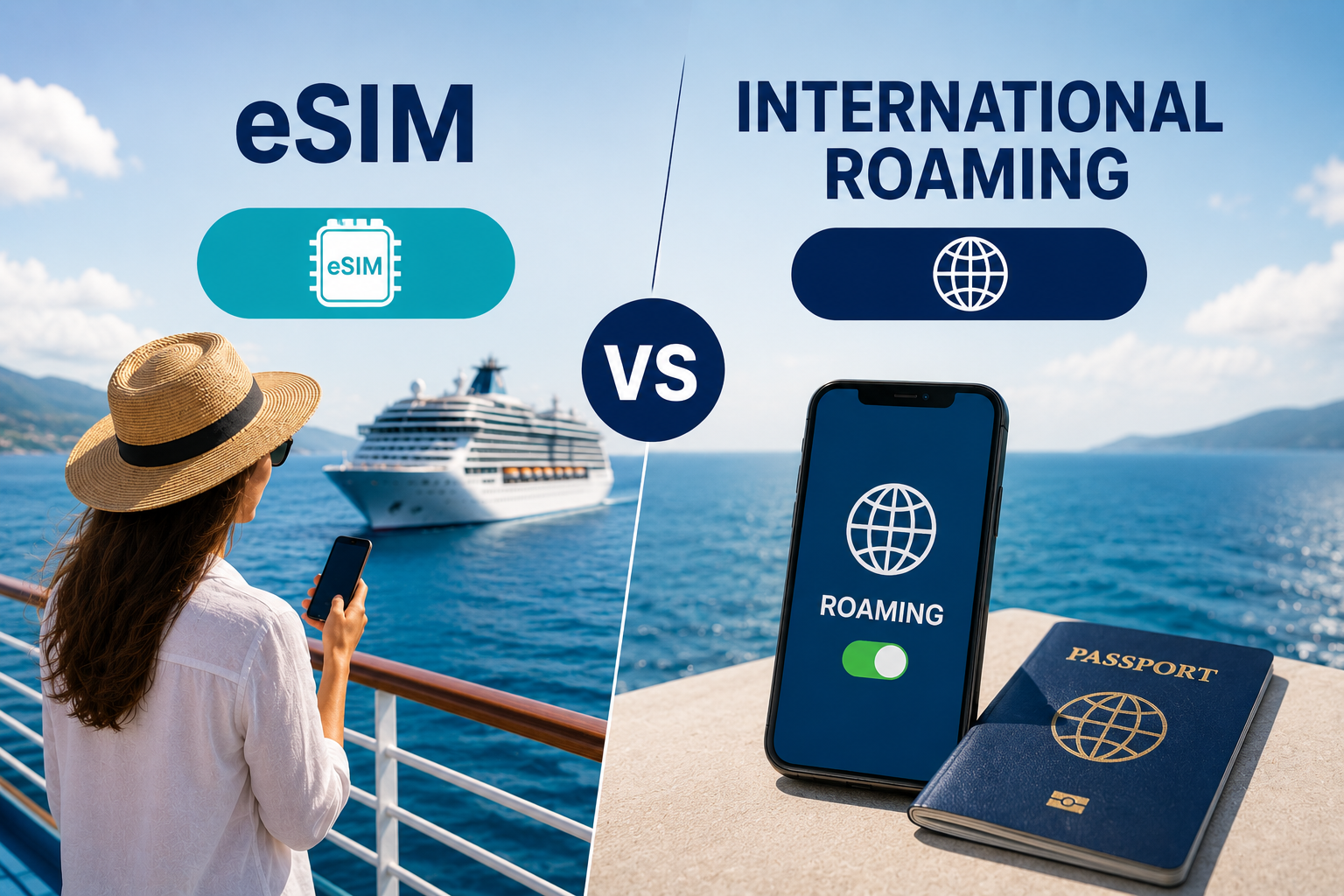
Staying connected on a cruise isn't as simple as it is on a typical international trip. While many travelers assume they can rely on their carrier's international roaming, using your phone at sea works differently than using it on land. Once your ship sails beyond the coast, your device may connect to a maritime network, where roaming charges can be significantly higher than expected.
A cruise eSIM is becoming a popular alternative, offering fixed-price mobile data on supported cruise ships and in many ports. But is it actually better than international roaming?
In this guide, we'll compare cruise eSIMs and international roaming side by side, looking at costs, coverage, convenience, and overall value to help you choose the best option for your next cruise.
Cruise eSIM vs International Roaming: Quick Answer
While both options let you stay connected during your cruise, a cruise eSIM is usually the better choice for most travelers. It's designed to provide predictable costs, easy setup, and connectivity on supported ships and in ports.
The biggest advantage of a cruise eSIM is predictable pricing. With international roaming, your phone may automatically connect to the ship's maritime network, where data rates are often much higher than on land. A cruise eSIM lets you pay upfront for a data plan, so you know what you'll spend before your trip and are much less likely to receive an unexpectedly large phone bill when you return home.
What Is International Roaming?
International roaming allows you to use your regular mobile plan when traveling outside your home country. Instead of connecting to your carrier's own network, your phone connects to a partner network in the country you're visiting. This lets you make calls, send texts, and use mobile data without changing your SIM card.
On land, international roaming usually works well because your carrier has agreements with local mobile operators. Many carriers also offer international roaming packages that include a fixed amount of data, calls, and texts for a daily or monthly fee.
Cruises are different. Once your ship sails away from the coast, it's no longer within range of land-based mobile towers. Instead, your phone usually connects to a maritime cellular network installed on the ship. These networks operate via satellite and are often billed separately from standard international roaming, which means using your phone at sea can be much more expensive than using it on land.
Read more: What Happens If You Leave Roaming On During a Cruise?
What Is a Cruise eSIM?
A cruise eSIM is a digital SIM card that provides mobile data while you're on a cruise. Instead of inserting a physical SIM card, you install the eSIM on your phone before your trip by scanning a QR code. Once activated, your device automatically connects to supported networks.
Unlike standard international roaming, a cruise eSIM is designed specifically for cruise travel. On supported cruise ships, it can connect to maritime cellular networks while you're at sea. Many cruise eSIM plans also include coverage in ports, allowing your phone to switch to supported local mobile networks when the ship docks.
Because everything is set up before you board, you can stay connected throughout your trip without swapping SIM cards or relying on your home carrier's roaming rates.
If you'd like to learn more about how cruise eSIMs work, read our guide: What Is a Cruise eSIM?
Cruise eSIM vs International Roaming: Key Differences
The table below highlights the main differences between a cruise eSIM and international roaming. While both can keep you connected, they differ significantly in cost, coverage, convenience, and the risk of unexpected charges.
Cruise eSIM | International Roaming |
|---|---|
Lower, fixed cost with prepaid plans | Can be very expensive, especially when your phone connects to maritime networks |
Simple digital setup—buy online, scan a QR code, and you're ready to go | No setup required, but your phone may automatically connect to costly roaming networks |
Works on supported cruise ships and in supported ports | Coverage depends on your home carrier's roaming agreements and may vary |
Lower risk of unexpected charges because you know your costs upfront | Higher risk of surprise bills if data roaming is left enabled |
No physical SIM card required | Uses your existing SIM, but convenience can come at a much higher cost |
For most travelers, a cruise eSIM offers the better balance of cost and convenience.
It provides fixed pricing, works on supported cruise ships and in many ports, and can often cover your entire itinerary with a single plan.
International roaming is convenient because it uses your existing SIM card, but costs and coverage depend on your carrier, and roaming at sea can become much more expensive than many travelers expect.
Read more: Is a Cruise eSIM Worth It?
Cruise eSIM vs International Roaming: Coverage Comparison
One of the biggest differences between a cruise eSIM and international roaming is how they provide coverage while you're at sea. Although both can keep you connected, they use different networks and can vary significantly in cost depending on your location.
At Sea
A cruise eSIM is designed specifically for cruise travel. On supported cruise ships, it connects to compatible maritime cellular networks, allowing you to use mobile data even when your ship is far from land. Coverage depends on your cruise line, ship, and eSIM plan, so it's important to check compatibility before you travel.
With international roaming, your phone also connects to a maritime network once the ship leaves the coast. However, this connection is made through your home carrier's roaming agreements. Coverage varies by carrier and cruise ship, and maritime roaming rates are often much higher than standard international roaming on land.
Read more: Does eSIM Work on a Cruise?
In Port
When your cruise arrives in port, both a cruise eSIM and international roaming will usually continue working, provided your destination is covered.
A cruise eSIM typically switches automatically from the maritime network to a supported local mobile network, so you can continue using mobile data without changing any settings.
With international roaming, your phone connects to one of your carrier's local roaming partners in the destination country. Coverage and speeds depend on your carrier's agreements and your roaming plan, but for most major cruise destinations, roaming is generally available.
Read more: Will My eSIM Work When the Cruise Arrives in Port?
When Should You Choose a Cruise eSIM?
A cruise eSIM is the better choice for most travelers who want affordable, hassle-free mobile data throughout their trip. It's especially worth considering if you:
Are taking a cruise lasting a week or longer.
Are visiting multiple countries on the same itinerary.
Need reliable mobile data both at sea (on supported ships) and in port.
Want to avoid expensive or unexpected roaming charges.
Prefer fixed, predictable costs before you travel.
When International Roaming Might Be Enough
International roaming may be a suitable option if your mobile carrier offers an affordable cruise roaming package or includes cruise coverage in your existing plan. It can also be enough if you're taking a short cruise, only need to check messages occasionally, or rarely use mobile data. Just remember to check your carrier's cruise roaming rates before you travel, as standard maritime roaming can be much more expensive than roaming on land.
Read more: Cruise Wi-Fi vs Cruise eSIM Cost: Which Saves You More Money?