Cruise Internet and Connectivity
Cruise Wi-Fi vs Cruise eSIM Cost: Which Saves You More Money?
You board the ship, settle in, and check the Wi-Fi price list: $20-30 a day, per device. For a week-long cruise, that's over $200 just to stay online.
Most people don't think about internet costs until they see that number. But connectivity is one of the biggest hidden expenses of a cruise. There's also a cheaper option many travelers overlook: an eSIM, which works the moment you step into port and doesn't lock you into a full-cruise package.
So which one actually saves you money? It depends on your itinerary and how you use data. This post breaks down the real costs so you can pick the cheaper option before your next cruise.
How Cruise Ship Wi-Fi Works
Do cruises have Wi-Fi? Yes, they do.
Cruise ship Wi-Fi runs on satellite internet. Most major lines (Royal Caribbean, Carnival, Norwegian, and Virgin Voyages) now use Starlink, which is faster than the old satellite systems but still costs more than internet on land, since the ship has to beam a signal to space and back for everyone onboard at once.
Cruise lines typically sell a few tiers:
Basic/social tier which covers messaging apps and social media, but blocks general browsing and streaming. Carnival's Social plan starts around $20.40 per person per day.
Mid tier which adds full browsing and email. Carnival's Value plan runs about $23.80.
Premium/streaming tier which supports video calls, streaming, and faster speeds. This is usually $30 to $90 per day, depending on the cruise line. Carnival's Premium plan is around $25.50, while Royal Caribbean's single Starlink-powered plan, VOOM Surf + Stream, runs a median of $19.99/night but can range from $17.99 to $39.91 depending on the ship and sailing dates.
Pricing is usually per device, per day, so a family of four buying Wi-Fi for a week can easily spend $500-$1,000+. Multi-device bundles exist and lower the per-device rate, but the total is still steep: Carnival's four-device Premium package runs about $90 a day, and Royal Caribbean's 4-device VOOM plan starts around $80/day, roughly $20 per device.
One thing to watch: prices aren't fixed. They're dynamic (like airline seats) and have been trending upward, meaning Carnival raised its Value, Premium, and Social plan prices in late 2025, and Disney followed with its own hike in early 2026. Booking your Wi-Fi package in advance, rather than once onboard, is usually cheaper.
How an eSIM Works?
An eSIM is a digital SIM card built into your phone. Instead of swapping a physical card, you install a data plan with a QR code or app before you travel. Once it's installed, your phone connects to local cell towers in whatever country or region you're in, just like a physical SIM would.
There are a few types of travel eSIM plans to choose from:
Single-country vs. regional plans: A single-country eSIM card covers just one destination and is usually the cheapest option per GB. Regional plans cover a group of neighboring countries (like all of Southeast Asia or the EU) for a bit more, which pays off if you're crossing borders during your trip. If you're only visiting one country, a single-country plan is almost always the better value.
Regional vs. global plans: Regional eSIMs cover one area (like Europe or Southeast Asia) and are usually cheaper. Global eSIMs cover multiple countries or continents, making them useful if your trip spans several regions.
Data-only vs. data + calls/texts: Most eSIM plans are data-only, which is fine for maps, messaging apps, and browsing. If you need to make actual phone calls or send SMS, look for a plan that includes voice and text, since not all providers offer it.
The catch: Regular travel eSIMs rely on cell towers, so they only work near coastlines and in port. Once the ship heads into open ocean, there's no signal. For connectivity at sea, you'd still need the ship's Wi-Fi or a cruise eSIM.
How a Cruise eSIM Works?
A regular travel eSIM and a cruise eSIM work the same way at a basic level. Both are digital SIM cards that connect you to mobile networks without swapping in a physical SIM. The difference is in which networks they can reach.
A regular travel eSIM connects to land-based cell towers, and many plans cover multiple countries at once. If your Mediterranean cruise stops in five different countries, a single international eSIM covering the whole region can be cheaper and simpler than buying a new local SIM at every port. The catch is that it only works within range of land, so once your ship sails out of range of shore, it typically loses signal.
A cruise eSIM is built to also connect to maritime cellular networks at sea. Many plans switch automatically between the ship's maritime network while sailing and local land networks once you're back in port, so you stay connected for more of the trip. Actual coverage still depends on the cruise line, the ship, your itinerary, and the specific plan you choose.
Read more: How to Stay Connected on Your Cruise with a Cruise eSIM
Cruise Wi-Fi Cost vs. eSIM Cost: A Side-by-Side Breakdown
Here's what the major cruise lines charge for Wi-Fi per day, and what that adds up to over a typical 7-day cruise. Cruise eSIM rates are listed at the bottom of the table for comparison.
Type | Plan | Per Day | Per Week (7 days) |
|---|---|---|---|
Wi-Fi | Carnival Social | $20.40 | ~$143 |
Wi-Fi | Carnival Value | $23.80 | ~$167 |
Wi-Fi | Carnival Premium | $25.50 | ~$179 |
Wi-Fi | Royal Caribbean (VOOM Surf+Stream) | ~$20–$39 | ~$140–$273 |
Wi-Fi | Norwegian | ~$29.99–$39.99 | ~$210–$280 |
Wi-Fi | Disney | $30–$49 | $210–$343 |
Wi-Fi | MSC | ~$16–$22 | ~$112–$154 |
eSIM | 1 GB (7-day plan) | $4.28 | $29.99 |
eSIM | 3 GB (15-day plan) | $3.80 | ~$26.60* |
eSIM | 5 GB (30-day plan) | $3.01 | ~$21.10* |
eSIM | 10 GB (30-day plan) | $5.54 | ~$38.80* |
*eSIM weekly figures are calculated from the per-day rate, since these plans are sold in 15- or 30-day bundles rather than by the week, you're paying for the full bundle whether you use 7 days or all 30.
Even the priciest eSIM option here (10 GB) comes in at roughly a quarter of the cheapest cruise Wi-Fi plan per day.
Cruise Wi-Fi vs. eSIM: Where Each One Wins
Where Cruise Wi-Fi Wins
Cruise Wi-Fi's biggest advantage is that it works everywhere on the ship, including in the middle of open ocean, far beyond the reach of any cell tower.
Cruise Wi-Fi is great if you need to join a video call, get work done, or stream something while the ship is sailing between ports.
It also scales reasonably well for families: bundling multiple devices under one plan lowers the per-device rate, so a family of four buying a shared package can end up paying less per person than they would buying separate eSIMs for everyone.
Where Cruise eSIM Wins
A cruise eSIM combines the strengths of both: it works in port like a regular eSIM, and also connects to maritime networks at sea, so you're never left offline once the ship sails out of range of land. In short, it's a combined cruise-and-land eSIM.
That means fewer gaps in coverage compared to a regular travel eSIM, without paying the daily rate that cruise line Wi-Fi charges.
The tradeoff is that maritime coverage and speeds vary by cruise line, ship, and route, so it's worth checking what a specific plan actually supports before relying on it for calls or heavier data use at sea.
Can I Use Both a Cruise eSIM and Ship Wi-Fi?
Yes. Many travelers combine the two to get the best mix of convenience and value. Rather than paying for a premium Wi-Fi package for the entire voyage, you can buy a cheaper onboard Wi-Fi tier and lean on your cruise eSIM whenever mobile coverage is available. This gives you more flexibility while keeping overall connectivity costs down.
Using both also lets you match the right connection to the right situation. Ship Wi-Fi works well for multiple devices at once, general browsing, or working from a laptop onboard.
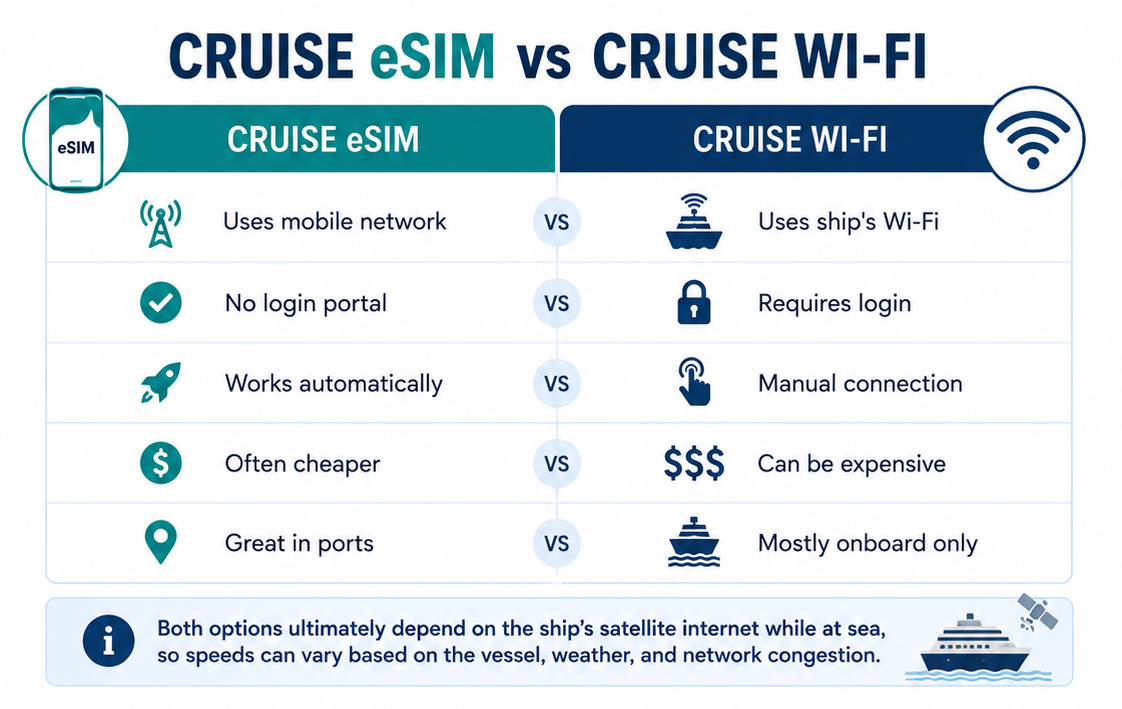
A cruise eSIM, on the other hand, gives your smartphone automatic mobile data without needing to log into the ship's Wi-Fi portal. It's handy for checking messages, using maps, using social media, or sending emails both at sea and while exploring ports.
In most cases, a cruise eSIM is the cheaper option on its own, since you're paying for the data you use instead of a flat daily rate. That's why ship Wi-Fi usually isn't worth adding unless your data needs go up - think streaming, video calls, or several devices needing a connection at once. If you only need messaging, maps, and light browsing, your eSIM for cruise alone may cover the whole trip for less, and Wi-Fi only earns its cost once you need more than that.
One thing to keep in mind: cruise eSIMs and onboard Wi-Fi both ultimately run through the ship's satellite connection. So speeds and reliability can still fluctuate depending on the ship's location, weather, and how many passengers are online at the same time.
Featured photo by cottonbro studio from Pexels