Cruise Internet and Connectivity
Why Is Cruise Ship WiFi So Expensive?
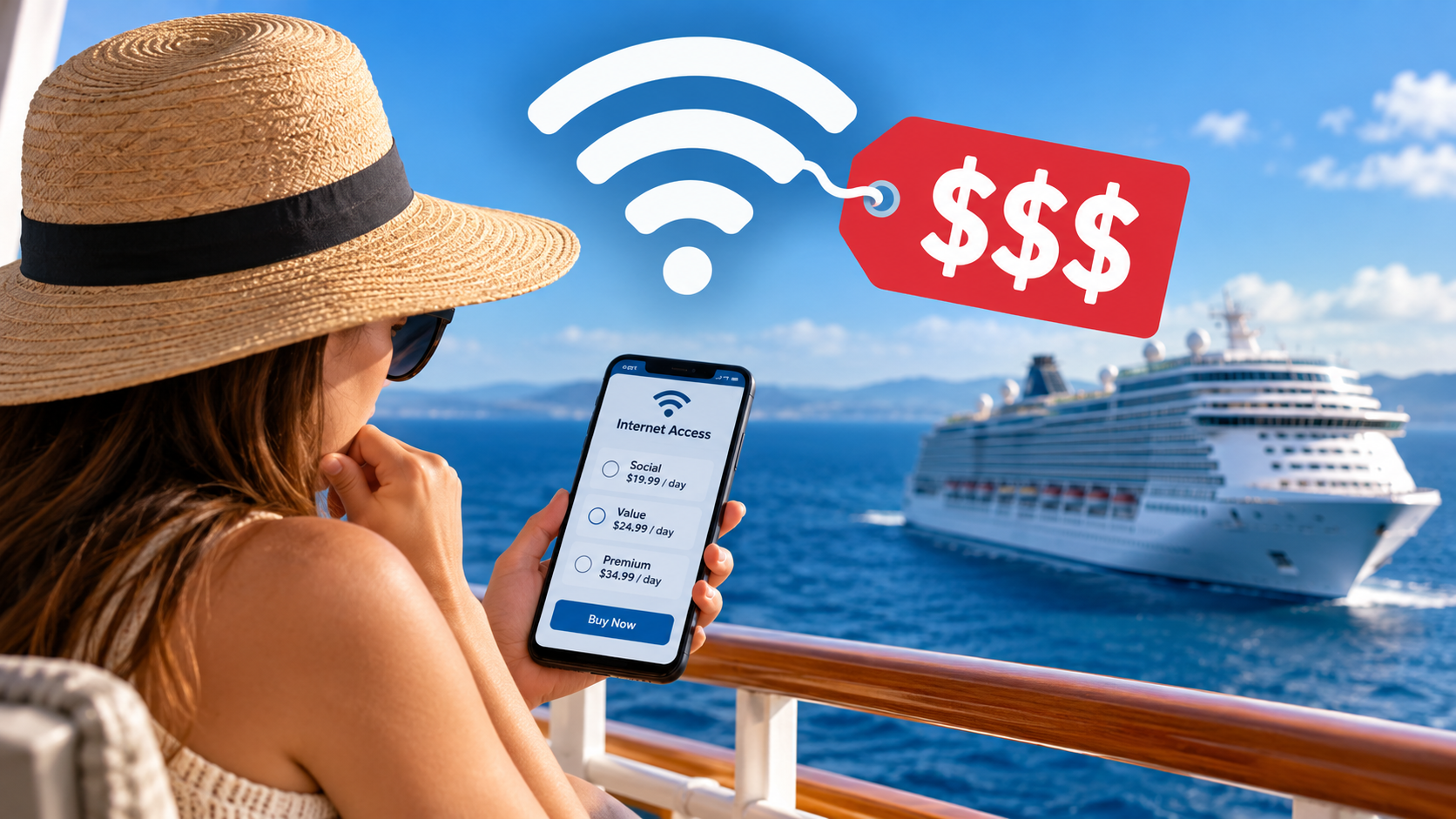
Cruise ship WiFi can be surprisingly expensive, especially when you've already paid for your cruise and other onboard services. While internet access is often free in hotels, staying connected at sea can cost significantly more.
So, why is cruise ship WiFi so expensive? The main reasons include satellite technology, high operating costs, shared bandwidth, and cruise line pricing strategies. Even though newer technologies like Starlink have made internet at sea faster and more reliable, WiFi packages can still be costly.
In this guide, we'll explain what makes cruise ship WiFi so expensive, how much it typically costs, and whether it's worth paying for.
We'll also explore cheaper alternatives, including cruise eSIMs and mobile data in ports.
Buy cruise eSIM online.
Why Is Cruise Ship WiFi So Expensive? Short Answer
Cruise ship WiFi is expensive because ships rely on satellite internet rather than traditional land-based networks.
Satellite equipment, bandwidth, maintenance, and network management increase operating costs. Internet bandwidth on a cruise gets split among thousands of people at once: a single mega-ship can carry 3,000 to 6,000+ passengers all pulling from the same connection simultaneously. Usage spikes make it worse on sea days, when there's no port wifi or cell signal to fall back on and nearly everyone is online at the same time, straining the network far more than on port days when many guests are off exploring.
On top of all that, maintaining antennas and equipment exposed to salt air, wind, and constant motion at sea requires specialized upkeep that land-based providers never have to worry about. It's another cost built into every wifi package.
Cruise lines also set their own internet prices, often charging separately for basic browsing, messaging, and streaming packages. Although newer technologies like Starlink have improved connectivity at sea, WiFi remains an additional expense on many cruises.
5 Reasons Why Cruise Ship WiFi Is So Expensive
Cruise ship WiFi costs more than regular internet because providing connectivity at sea requires specialized technology and infrastructure. However, technical expenses aren't the only reason for high prices. Cruise lines also determine how much passengers pay for internet access.
Here are five main reasons why WiFi is so expensive on cruise ships.
1. Cruise Ships Rely on Expensive Satellite Internet
Unlike hotels and homes, cruise ships cannot connect to traditional fiber-optic networks while sailing far from shore. Instead, they rely on satellite internet to provide connectivity at sea.
Cruise ships typically use two types of satellite technology:
Geostationary Earth Orbit (GEO) satellites: Traditional satellites positioned approximately 35,786 kilometers above Earth. They provide wide coverage but generally have higher latency.
Low Earth Orbit (LEO) satellites: Newer systems, such as Starlink, operate much closer to Earth, offering lower latency and potentially faster connections.
Both technologies require specialized onboard equipment, satellite bandwidth, installation, maintenance, and technical support.
Although Starlink and other modern satellite systems have improved cruise internet performance, providing satellite connectivity still involves significant costs.
Read more: How Cruise Ship Internet Works (Satellite Explained)
2. Thousands of Passengers Share the Same Connection
On large cruise ships, thousands of passengers and crew members may share the same internet connection.
Unlike home WiFi, where only a few devices typically connect simultaneously, cruise ship networks must accommodate many users browsing websites, sending messages, streaming videos, and making video calls.
The more people using the internet simultaneously, the greater the demand for available bandwidth.
During busy periods, such as evenings or sea days, network congestion can reduce speeds.
To manage demand, cruise lines may limit connection speeds, restrict certain activities, or offer premium internet packages with different performance levels.
3. Maintaining Internet at Sea Is Complicated
Providing reliable internet on a moving cruise ship is more complicated than maintaining a connection in a hotel.
Cruise ships travel through different geographic regions, sometimes far from land-based infrastructure. Satellite coverage and connection quality can change throughout the journey.
Several factors can affect connectivity:
Ship movement: Equipment must maintain connections while the vessel moves.
Weather conditions: Heavy rain and severe weather can affect satellite signals.
Satellite coverage: Availability and capacity vary by location.
Network transitions: Ships may switch between satellites or connectivity systems.
Cruise operators also need specialized equipment, technical support, and sometimes backup connections to maintain internet access throughout the voyage.
4. Cruise Lines Charge for Different Internet Packages
Many cruise lines do not include unlimited WiFi in their standard fares. Instead, passengers must purchase separate internet packages.
These packages often differ based on:
Internet speed: Basic browsing versus higher-performance connections.
Usage: Messaging and browsing versus streaming and video calls.
Number of devices: Single-device or multi-device packages.
Duration: Daily access or packages covering the entire cruise.
Premium packages generally cost more, particularly when they support bandwidth-intensive activities.
Some cruise lines also offer discounts when passengers purchase internet access before boarding.
5. Cruise WiFi Is an Additional Revenue Source
Satellite technology and maintenance explain part of the high cruise ship WiFi cost, but pricing is also a commercial decision.
Cruise lines generate additional revenue by selling services beyond the basic cruise fare, including specialty dining, drinks, excursions, and internet packages.
Since many passengers want to stay connected throughout their vacation, internet access can be a valuable onboard service.
Passengers who need WiFi for work, communication, or entertainment may also be willing to pay more for reliable connectivity.
Ultimately, cruise WiFi prices reflect both the cost of providing internet at sea and the cruise line's pricing strategy. This is why improved satellite technology does not necessarily translate into cheaper internet packages for passengers.
Why Is Cruise Ship WiFi Sometimes Slow Despite Being Expensive?
Even though cruise ship WiFi can be expensive, paying more doesn't always guarantee a fast or reliable internet connection. Unlike land-based networks, cruise ships depend on satellite technology, which has certain technical limitations.
One of the main reasons for slow cruise WiFi is shared bandwidth. Thousands of passengers and crew members may use the same connection, especially during sea days and evenings. When many people stream videos, make video calls, or download files simultaneously, internet speeds can decrease.
Satellite coverage and network congestion also affect performance. Ships travel through different regions, and connection quality can vary depending on their location, available satellite capacity, and weather conditions. Higher latency can also make websites and video calls feel less responsive.
Additionally, some cruise lines offer different internet packages. Basic plans may have speed restrictions or limit streaming, while premium packages typically support more data-intensive activities.
Fortunately, Starlink and other modern satellite systems have significantly improved cruise ship internet speeds and latency on many vessels. However, actual performance still varies between cruise lines, ships, providers, and itineraries.
Will Cruise Ship WiFi Get Cheaper in the Future?
Cruise ship WiFi could become more affordable as satellite technology improves and competition increases. Newer Low Earth Orbit (LEO) satellite networks, including Starlink, are already improving internet speeds, reducing latency, and expanding connectivity options for cruise operators.
As more satellite providers enter the market, increased competition could help reduce the cost of delivering internet at sea. This may allow cruise lines to offer better internet packages at more competitive prices.
Another possibility is that more cruise lines will start including basic WiFi in their standard fares, particularly as passengers increasingly expect internet access to be part of their travel experience.
However, lower operating costs don't necessarily mean lower prices for passengers. Cruise lines determine their own WiFi pricing strategies, and internet packages remain an additional revenue source.
Can You Get Free WiFi on a Cruise Ship?
Free WiFi is available on some cruise ships, but most cruise lines don't include unlimited internet access in their standard fares. Passengers usually need to purchase a separate WiFi package to browse websites, use social media, or stream content.
However, there are several ways to access free internet during a cruise:
Cruise packages with included WiFi: Some premium fares, promotional offers, and all-inclusive packages include internet access.
Loyalty program benefits: Certain cruise lines offer complimentary or discounted WiFi to passengers with higher loyalty status.
Cruise line apps: Many ships allow passengers to use their official onboard apps for free to check schedules, make reservations, or access ship information. However, this doesn't necessarily include general internet browsing.
Free WiFi in ports: Some cruise terminals, cafés, restaurants, and public areas offer complimentary WiFi when the ship is docked.
If free WiFi isn't available, consider using a travel eSIM in ports or a cruise eSIM at sea to reduce connectivity costs. More on this below.
Read more: Cruise Wi-Fi vs Cruise eSIM Cost
Cruise Ship WiFi Alternatives (Other Internet on Cruise)
If you don't want to pay for expensive onboard WiFi, there are several cruise ship WiFi alternatives worth considering.
Cruise eSIMs provide mobile internet at sea through supported maritime networks, while regional and country-specific travel eSIMs offer internet access in ports and near shore. You can also use your regular mobile plan when terrestrial coverage is available, although international roaming charges may apply. Another option is free WiFi at cruise terminals, cafés, and restaurants in port.
The best alternative depends on your itinerary, data needs, and budget. Your best choice overall would be cruise eSIM for days at sea, and a regular travel eSIM for days exploring the port cities.
Cruise eSIMs offer cheap internet on cruise ships while travel eSIMs are known as cheap international SIM alternatives.
Read more:
Is Cruise Ship WiFi Worth It: When Is Cruise Ship WiFi Better Value?
Although a cruise eSIM can be cheaper, cruise ship WiFi may be worth the additional cost in certain situations.
For example, if you plan to work remotely, attend video meetings, stream movies or connect multiple devices, an onboard WiFi package may be more suitable.
Cruise ship WiFi may offer better value when:
You need internet access on a laptop, tablet and smartphone.
You regularly make video calls or stream content.
You require a larger data allowance than a cruise eSIM bundle provides.
Your cruise line offers discounted or complimentary WiFi.
You need connectivity throughout the ship, including areas where maritime cellular reception may be limited.
Some cruise lines also include WiFi in certain cabin categories or promotional packages, making it unnecessary to purchase a separate internet plan.
How Much Does WiFi Cost on a Cruise Ship?
Cruise ship WiFi typically costs around $15–$40 per device per day, although actual prices vary depending on the cruise line, internet package, and sailing. Premium packages that support streaming and video calls may cost more.
The total cruise ship WiFi cost also depends on how many devices you want to connect and whether you purchase internet before departure or onboard. Some cruise lines offer discounted rates for advance bookings, while others include WiFi in selected cruise packages.
For example, at $25 per day, internet access for a 7-day cruise would cost approximately $175 for one device. For two devices, the total could reach $350 if each requires a separate package.
Cruise Ship WiFi Price Comparison by Cruise Line
The table below compares advertised WiFi packages from major cruise lines, based on information available in October 2026.
Cruise line | Internet package | Daily price (USD) | Streaming available? |
|---|---|---|---|
Royal Caribbean | VOOM Surf + Stream | Varies by sailing | Yes |
Carnival | Social / Value / Premium | From $20.40 / $23.80 / $25.50 | Premium only |
Norwegian Cruise Line | Voyage / Streaming Voyage | $29.99 / $39.99 | Streaming Voyage |
MSC Cruises | Browse / Browse & Stream | Varies by sailing | Browse & Stream |
Some premium cruise fares, loyalty benefits, and promotional packages include complimentary or discounted internet access. Before purchasing WiFi, check whether your booking already includes it.