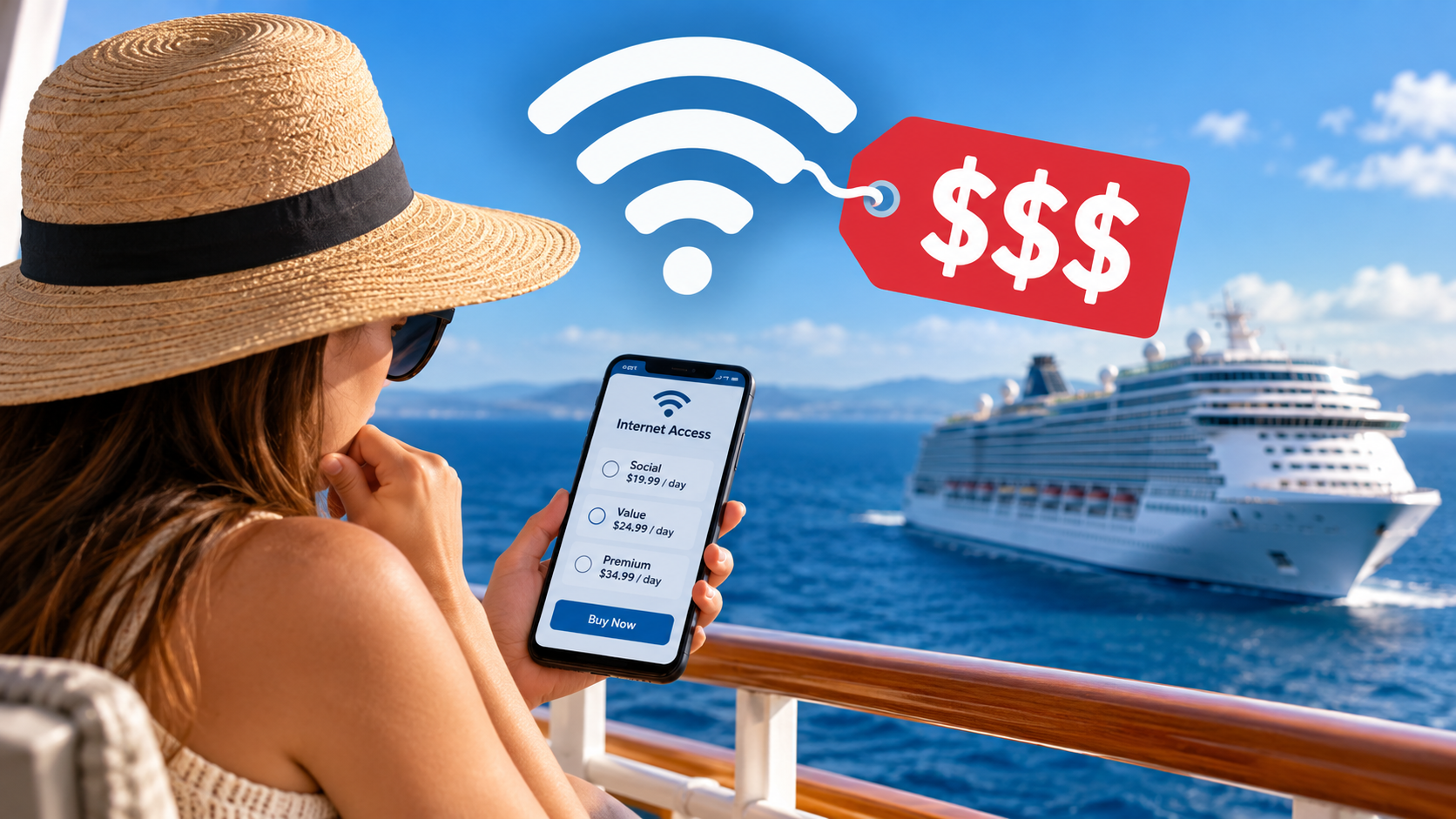
Cruise Internet and Connectivity
Why Is Roaming Expensive on Cruise Ships

Cruise data roaming can be surprisingly expensive, especially when your ship travels between multiple countries and connects to different mobile networks along the way. Unlike regular international travel, cruising involves both land-based mobile networks and specialized maritime networks, each with its own roaming rates and agreements.
But why is cruise data roaming so expensive? The main reasons include high maritime roaming fees, different pricing structures across countries and mobile providers, and the use of satellite connections at sea. Even a small amount of mobile data can result in unexpected charges.
In this guide, we'll explain what makes cruise roaming so expensive, how charges vary throughout your journey, and how to avoid costly roaming bills while staying connected at sea.
Buy cruise eSIM online.
Why Is Roaming Expensive on Cruise Ships? Quick Answer
Cruise data roaming is expensive because ships at sea have no cell towers and must route all phone data through costly, limited satellite links.
Beyond the reach of land-based networks, phones connect to specialized maritime cellular networks that depend on satellite backhaul, dedicated onboard equipment, and infrastructure far more expensive to operate and maintain than a traditional mobile network.
Maritime operators charge mobile providers wholesale roaming fees, and those costs flow through to passengers. Several companies (the satellite provider, the onboard cell network operator, the cruise line, and your home carrier) each add their own markup, and with no competing alternative at sea, there is little pressure to bring prices down.
The problem is compounded by the nature of a cruise itself. Unlike a holiday in a single country, a cruise can cross several international roaming zones, each with its own agreements, infrastructure costs, and pricing structures, which makes connectivity costs higher and far less predictable.
In port, phones that stay connected to the ship's network or fall back on standard international roaming can still be charged premium rates. On top of that, standard roaming packages typically exclude maritime coverage altogether, so without a dedicated cruise plan, passengers may be billed per megabyte, and even small amounts of data can produce substantial charges.
To avoid these fees, travelers can use the onboard Wi-Fi, enable Airplane Mode when they don't need cellular connectivity, or buy a prepaid cruise eSIM with maritime coverage. A cruise eSIM is often one of the most cost-effective options, offering transparent upfront pricing and helping travelers avoid unexpected data roaming bills.
How Does Data Roaming Work on a Cruise Ship?
Data roaming on a cruise ship works differently depending on whether you're sailing at sea or visiting a port.
Your phone can connect to two types of mobile networks: land-based cellular networks and maritime cellular networks, each with different coverage, roaming agreements and pricing.
International Roaming in Ports and Coastal Areas
When your cruise ship docks in a foreign country or sails close to the coastline, your phone may connect to a local mobile network. Your home mobile provider then charges you according to its international roaming agreements.
Roaming rates can change as your cruise travels between countries. For example, a Mediterranean cruise visiting Spain, France, Italy and Tunisia may involve different roaming charges. Eligible EU/EEA mobile plans generally allow roaming in Spain, France and Italy at domestic rates, subject to fair-use rules. However, Tunisia is outside the EU/EEA roaming zone and may have significantly higher rates.
Similarly, US travelers taking a Caribbean cruise may face different roaming charges when visiting destinations such as Mexico, the Bahamas, Jamaica and the Cayman Islands. Many US mobile providers include roaming in Mexico and Canada in selected domestic plans, but coverage in Caribbean countries varies depending on the provider and mobile plan. While some destinations may be included at no additional cost, others may require a daily international roaming pass or incur expensive pay-per-use charges.
Unlike the EU/EEA, there is no equivalent region-wide roaming agreement covering the US and Caribbean countries. Therefore, US cruise passengers should check their mobile provider's roaming rates for every destination on their itinerary, as well as separate maritime roaming charges that may apply while sailing between ports.
International Roaming on Cruise Ships (Maritime Roaming While Sailing at Sea)
When your ship travels beyond the coverage of land-based networks, your phone may connect to an onboard maritime cellular network, such as Cellular at Sea. It results in cruise ship roaming charges.
Cruise ships essentially operate as floating mobile base stations. Your phone connects to small onboard cellular base stations (picocells), which use satellite connections to transmit calls, text messages and mobile data between the ship and terrestrial telecommunications infrastructure.
Providing mobile connectivity at sea requires specialized satellite antennas, onboard networking equipment, satellite bandwidth and ongoing maintenance. These additional infrastructure and operational costs make maritime roaming significantly more expensive than regular international roaming.
Most standard international roaming packages exclude maritime coverage. Since your phone may automatically connect to maritime networks, you could incur substantial roaming charges without realizing it.
Unlike maritime roaming, cruise ship Wi-Fi connects passengers through onboard wireless access points. Although both services may rely on satellite technology, they have separate access methods, pricing structures and billing systems. Cruise Wi-Fi can still be expensive, though. Ships pay high rates for satellite capacity, and that limited bandwidth is shared among thousands of passengers and crew, so cruise lines price packages high to keep the connection usable for everyone. Passengers also have no competing option once the ship leaves port, which gives cruise lines little reason to lower prices.
Many travelers use a cruise eSIM to save money on internet at sea. Instead of paying per megabyte through maritime roaming or buying an expensive onboard Wi-Fi package, they install a prepaid data plan before the trip and activate it when they board. Pricing is fixed upfront, so there are no surprise bills after the cruise. Many plans also cover multiple countries and ports, which means one eSIM can stay active from departure to docking without switching networks.
Read more:
Select your cruise line and ship to view available plans and pricing.
Why Is Roaming Expensive on Cruise Ships: 10 Reasons
Cruise data roaming costs can be significantly higher than regular international roaming because cruise ships travel between countries, use different mobile networks and rely on specialized maritime connectivity.
Here are six main reasons why roaming charges can add up quickly during a cruise.
1. Satellite Is the Only Option
Once a ship is beyond roughly 12 nautical miles from shore, there are no cell towers to connect to.
Ships depend on satellite links.
Cruise ships typically use two types of satellite technology:
Geostationary Earth Orbit (GEO) satellites: Traditional satellites positioned approximately 35,786 kilometers above Earth. They provide wide coverage but generally have higher latency.
Low Earth Orbit (LEO) satellites: Newer systems, such as Starlink, operate much closer to Earth, offering lower latency and potentially faster connections.
Both technologies require specialized onboard equipment, satellite bandwidth, installation, maintenance, and technical support.
Geostationary satellites sit about 22,000 miles above Earth, which adds noticeable delay to every request. Slow connections often cause apps to retry, reload, and resync, using more data than you intended. Background activity like cloud photo backups, email fetching, and app updates can quietly burn through your allowance or run up a roaming bill.
Starlink satellites orbit at roughly 340 miles above Earth, far closer than traditional geostationary satellites, which cuts delay to a fraction of what older maritime connections deliver. Faster responses mean apps are less likely to retry, reload, and resync, so less data is wasted on repeated requests. Even so, a quicker connection makes it easier for background activity like cloud photo backups, email fetching, and app updates to run unnoticed, and on a metered plan or a roaming connection that data can still add up quickly.
Read more: How Cruise Ship Internet Works (Satellite Explained)
2. Maritime Satellite Contracts Are Pricey
Marine satellite providers such as Inmarsat and Intelsat charge significantly more than land-based carriers.
Ships also need stabilized antennas that keep tracking a satellite while the vessel pitches, rolls, and changes course. That hardware is expensive to buy, install, and maintain, and cruise lines recover those costs through what passengers pay.
Also, several companies sit between you and the internet: the satellite operator, the cell-at-sea provider, the cruise line, and your home carrier. Each takes its own cut, so the final price stacks up in layers. By the time the charge reaches your bill, it can bear little resemblance to the underlying cost of the data.
3. Bandwidth Is Scarce and Shared
A ship carrying 3,000 to 6,000 passengers plus crew shares one limited pool of satellite capacity.
The cruise line pays for a fixed amount of bandwidth, so every gigabyte is effectively rationed. Pricing is also used as a control tool: high rates discourage heavy streaming and downloads that would slow the connection for everyone else.
4. The Ship's Cell Network Acts Like a Mini Carrier
"Cellular at Sea" systems place a small cell tower on board so your phone works as if it were on a normal network.
Behind the scenes, all your calls, texts, and data travel over the satellite link back to shore. The cost of that backhaul is billed to your home carrier, which passes it along to you, often at a markup.
5. Carriers Charge Premium Maritime Rates
Roaming on a ship network is priced very differently from standard international roaming.
Carriers are billed at satellite wholesale rates, so they often charge per megabyte or per minute, and those rates can be many times higher than what you'd pay in a foreign country. Because a single photo upload can use several megabytes, charges add up quickly.
6. No Competition, So Prices Stay High
Once the ship leaves port, your phone can only connect to the maritime network, so you can't switch to a cheaper provider or pick up a local SIM with a better data plan.
Carriers know that demand for mobile data is strong and that competition at sea is nonexistent, so they can set roaming rates as high as passengers will tolerate. Maritime roaming has also become a reliable source of revenue for carriers and network operators, which gives them little incentive to bring per-megabyte prices down.
7. Your Phone May Stay Locked to the Ship's Network
Near a coastline, your phone can keep connecting to the ship's cellular signal instead of a local tower, especially if the ship is docked and the signal is strong.
You then keep being billed at maritime rates even though you're standing in a port city with perfectly good local coverage.
When your phone does connect to a local tower, you're subject to your carrier's regular international roaming rates. Without a travel pass or add-on, these can still be steep, charged per day or per megabyte.
Since cruises often visit several countries in one trip, you may face different rate zones and rules at each stop.
8. Every Mobile Provider Has Different Roaming Agreements
Cruise roaming charges depend heavily on your home mobile provider and its agreements with international and maritime network operators.
For example, two passengers on the same cruise ship could connect to the same maritime network but pay completely different rates.
Some mobile providers offer special cruise roaming packages with fixed data allowances, while others charge standard pay-per-use rates.
This means there's no universal cruise roaming price. Always check your provider's specific maritime roaming rates before boarding.
9. Standard International Roaming Packages Often Exclude Cruises
Many travelers assume that purchasing an international roaming package means they can use mobile data anywhere during their trip.
However, most international roaming packages cover land-based networks in selected countries, not maritime cellular networks.
Even packages advertised as unlimited international roaming may exclude cruise ships, ferries and satellite-based mobile services.
As a result, passengers who use their regular SIM at sea may face additional roaming charges despite already paying for an international data package.
10. Maritime Data Roaming Can Be Charged Per MB
Many mobile providers charge maritime roaming on a pay-per-use basis, meaning you pay for every megabyte of data consumed.
This can become expensive very quickly, especially when browsing websites, sending photos or using social media.
For example, if your provider charges €5 per MB, the costs would be:
Data used | Roaming cost |
|---|---|
10 MB | €50 |
50 MB | €250 |
100 MB | €500 |
These are illustrative calculations. Actual cruise roaming fees vary by mobile provider and network.
Unlike prepaid data packages, pay-per-use roaming can make it difficult to predict your final bill.
Why Do Roaming Charges Change During the Same Cruise?
Roaming charges can change several times during a single cruise, sometimes even within the same day.
This is because cruise ships travel between different countries, mobile network coverage areas and international roaming zones, each with its own pricing structure.
When your ship is docked or sailing close to the coastline, your phone may connect to a land-based mobile network.
As the ship moves further offshore and loses terrestrial coverage, your phone may automatically switch to an onboard maritime cellular network, where significantly higher roaming rates may apply.
Cruise location | Network type | Typical billing situation |
|---|---|---|
Departure port | Local terrestrial network | Domestic or international roaming rates |
At sea | Maritime cellular network | Separate maritime roaming rates |
Foreign port | Local terrestrial network | Country-specific roaming rates |
Near the coastline | Terrestrial or maritime network, depending on availability | Charges depend on the network used |
Back at sea | Maritime cellular network | Maritime roaming rates may apply again |
One of the biggest risks of cruise data roaming is that switching between mobile networks can happen automatically. You could be browsing the internet at affordable international roaming rates one moment and paying considerably higher maritime roaming rates shortly afterwards, without changing any settings on your phone.
This constant transition between networks, countries and pricing structures makes cruise data roaming particularly unpredictable and difficult to budget for.
How to Avoid Roaming Charges on a Cruise
The simplest way to avoid roaming charges on a cruise is to keep your phone off the cellular network altogether.
Switch on Airplane Mode, then turn on Wi-Fi so you can use the ship's internet package without triggering maritime roaming rates.
Before boarding, disable data roaming and background app refresh so your phone doesn't quietly sync photos or updates, and set your network selection to manual so it doesn't latch onto the ship's cellular signal, especially when docked.
For ports of call, a prepaid cruise eSIM with maritime and multi-country coverage is often the most cost-effective option, offering clear upfront pricing instead of unpredictable per-megabyte charges.
Cruise Internet Comparison: Cruise Ship Roaming vs Wi-Fi vs eSIM for Cruise
There are three main ways to stay connected at sea: international data roaming, cruise ship Wi-Fi and a cruise eSIM. While all three provide internet access on supported cruise ships, they differ significantly in terms of technology, pricing, coverage, flexibility and the risk of unexpected charges.
The table below compares the three cruise internet options to help you choose the most suitable and cost-effective solution.
Feature | Cruise Data Roaming | Cruise Ship Wi-Fi | Cruise eSIM |
|---|---|---|---|
Connection | Regular SIM via partner networks | Ship's onboard Wi-Fi network | Supported maritime cellular networks |
Technology | Maritime cellular and satellite technology | Wi-Fi and satellite technology | Maritime cellular and satellite technology |
Pricing model | Pay-per-use or dedicated roaming packages | Daily or entire cruise packages | Prepaid data packages |
Relative cost | Often very high | Moderate to high | Often lower for light to moderate usage |
Cost predictability | Low with pay-per-use roaming | High | High |
Works at sea | Yes, on supported maritime networks | Yes | Yes, on supported maritime networks |
Works in port | Depends on international roaming coverage | Generally onboard the ship | Yes, if supported. Keep it mind that some plans are sea only. |
Data allowance | Provider-dependent | Package-dependent | Fixed data allowance or unlimited data for supported apps |
Risk of unexpected roaming charges | High with pay-per-use roaming | None from Wi-Fi itself | Low when correctly configured |
Installation required | No | No, but login may be required | Yes |
eSIM-compatible device required | No | No | Yes |
Purchase before departure | Optional | Optional | Recommended |
Flexibility | Depends on mobile provider | Depends on cruise line and package | Choice of data packages and validity periods |
Best for | Travelers with suitable cruise roaming packages | Passengers with high data needs | Travelers looking for affordable, prepaid internet at sea |
A cruise eSIM is often one of the most cost-effective alternatives to expensive maritime roaming, particularly for travelers who primarily use messaging apps, emails, social media and web browsing.
Cruise ship Wi-Fi may be more suitable for passengers with higher data requirements, while traditional data roaming can be convenient for those whose mobile providers offer competitively priced cruise-specific packages.
Ultimately, the best cruise internet option depends on your itinerary, data consumption, budget and supported network coverage.
Read more:
Featured photo by Ibrahim Boran from Pexels